This tab exists because a subscriber asked for it. A player named Barry left a comment on my channel: “How about a lesson of Foggy Mountain Breakdown up the neck.” So this week I taught it, and here is the tab to go with it, written out the same way I hand it to my students in the shop.
Watch the Free Lesson
The Tab
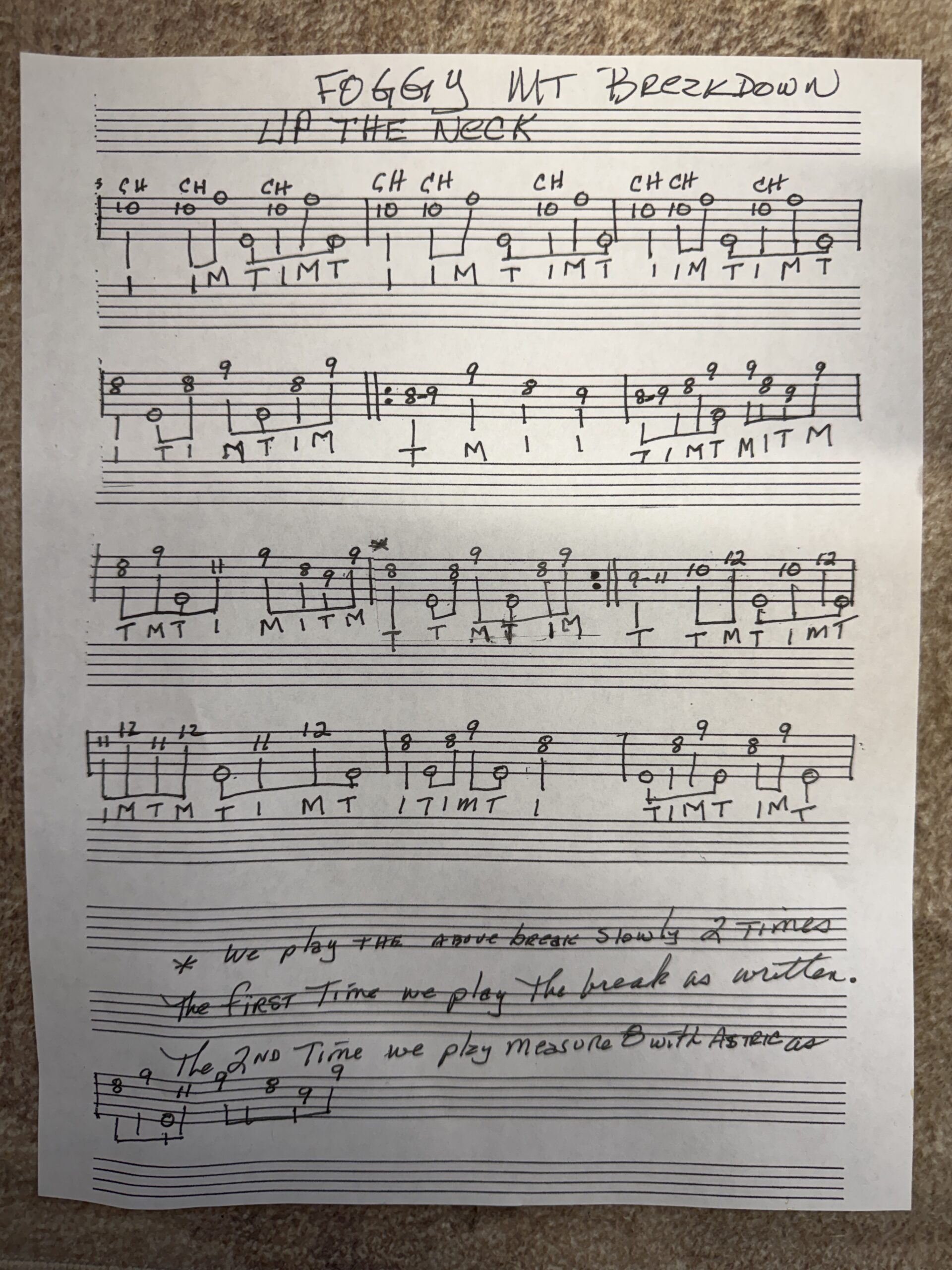
How to Read This Break
The letters under the notes are your right hand: T is your thumb, I is your index finger, M is your middle finger. CH over a note means choke: you note the string, pick it, and push the string upward to bend the pitch. The numbers are frets, and this whole break lives high on the neck, mostly between the 8th and 12th frets.
There are three chokes in the very first measure, all at the 10th fret. Getting those three to speak clearly is the foundation of the entire break, and at first you will need to push with a little extra force to get the full sound. Play that first measure until it sounds like mine before you go anywhere else. In the song, that measure comes three times in a row.
Watch for the slide in measure five, that is the Foggy Mountain sound, and for the stretch in measure seven, where your pinky has to reach and the note after it still has to ring clearly. If the pinky note is muting, rotate your hand by dropping your shoulder a little. In measure nine you slide the whole position up two frets while your ring finger moves to the 12th fret, so the shape travels together.
How the Break Repeats
We play this break through twice, slowly. The first time, play it exactly as written. The second time through, play measure eight using the alternate measure marked with the asterisk at the bottom of the page instead. That small change is what keeps the second pass driving forward instead of just repeating itself.
How to Practice It
Play it slowly and play it correctly. The goal is to play each measure perfectly the first time, and then to be able to play it five times through without an error, before you ever speed it up. Pause the video anywhere, listen to me play a measure, then you play it. That is how this break goes from impossible to automatic, and it is how I have taught every student who ever learned it from me.
If there is a song or technique you want me to teach next, leave a comment on the video or reply to any of my emails. This lesson happened because somebody asked. Yours can too.
Want free weekly lessons in your inbox?
Join my email list for a free banjo lesson every week, plus first word when special banjos arrive at the shop.